
How is insurance different from savings or cooperative schemes?
Kindly leave a comment and share
Blessing Chuks Okonta
Insurance, savings and cooperative schemes all involve putting money aside, but they are not the same. Each serves a different financial purpose, and confusing one for the other can leave individuals and businesses exposed when unexpected losses occur.
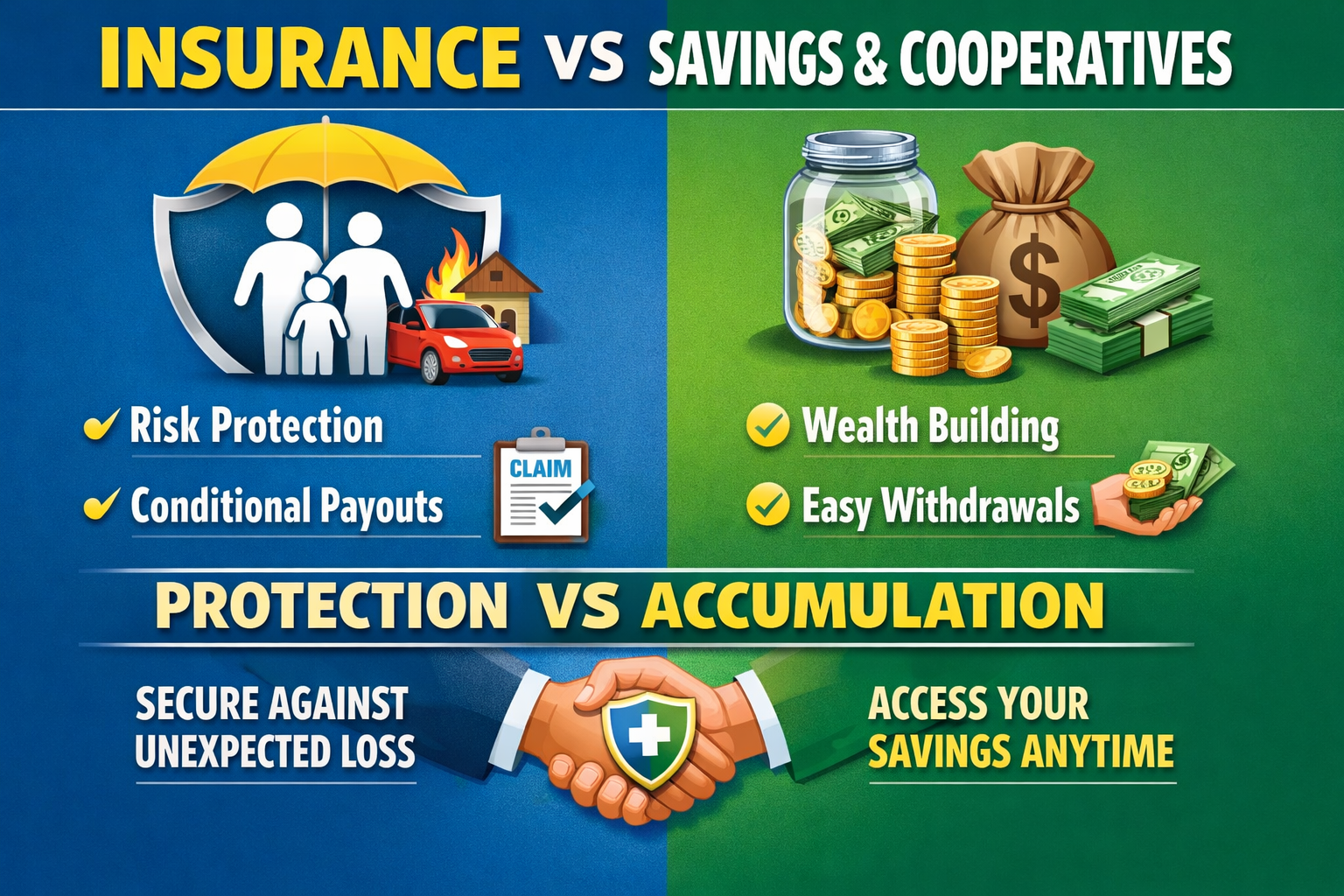
Insurance exists primarily to provide financial protection against unforeseen risks such as accidents, illness, fire, theft or death. Policyholders pay premiums to transfer these risks to an insurance company, which agrees to compensate them when covered events occur.
Savings and cooperative schemes are designed for wealth accumulation and planned expenses. They help individuals build funds gradually for needs such as education, business expansion, housing or emergencies.
Insurance operates on the principle of risk pooling. Many policyholders contribute premiums into a common pool, and claims are paid to those who suffer insured losses. This structure allows a policyholder to receive compensation that may be far higher than the total premiums paid.
Savings and cooperatives rely on individual contributions. Withdrawals are limited to the amount saved, sometimes with interest or dividends. In the event of a major or sudden loss, accumulated savings may be insufficient.
Compensation is paid only when an insured event occurs and the claim complies with policy terms and conditions.
Savings and cooperative schemes allow contributors to withdraw their funds, subject to agreed rules, without the need to prove loss or damage.
Insurance companies are typically regulated by statutory authorities and operate under strict legal and solvency requirements. Insurance policies are legally enforceable contracts.
Many cooperative and savings schemes are less regulated or informal. While some are well managed, others may offer limited legal protection if the scheme fails or collapses.
Complementary, Not Competing Tools
Insurance is not a substitute for savings, and savings cannot replace insurance. Savings help meet planned financial goals, while insurance provides protection against unexpected, high-impact risks.
A balanced financial plan combines both insurance and savings. Savings build financial resilience over time, while insurance provides a safety net when unforeseen events threaten financial stability.
Understanding the difference helps individuals make
informed decisions and avoid costly assumptions.